Sunday, 11 January 2015

PEDIATRIC DENTISTRY - DENTAL SPECIALITY EXCLUSIVELY FOR CHILDREN

About Pediatric Dentistry…
Pediatric Dentistry is a specialized branch of dentistry developed for dental care of infants and children through their adolescence.

It provides complete oral health care for children with prevention as well as treatment of all kinds of dental problems including:
- Cavities
- Injuries to teeth
- Aesthetics
- Problems of gums
- Abnormal habits like thumb sucking
- Problems related to crooked teeth etc.

It also provides dental care for children with special health care needs such as disabled children or those with medical problems   

How is it different from adult’s dentistry/general dentistry?...
Children do not enter the dental clinic as readily as adults. Fear of unknown or anxiety about dentistry or simply the lack of maturity and coping ability due to young age prevents them from accepting the dental treatment easily.
                                  
Pediatric dentistry is an art and science that includes variety of techniques to modify the child’s behavior in the dental clinic, alleviate their anxiety and slowly guide them through the dental experience so that dental treatment can be readily accepted by them.

For example, one of the techniques called as “Tell-Show-Do” includes stepwise description of the dental procedure to child in a way he/she will understand before actually performing it.     

The pediatric dentist…
Pediatric dentists are trained in child psychology that enables them to communicate with children and help the anxious and uncooperative child relax in the dental operatory. Based on the concepts of child psychology at different ages, they use variety of techniques to help children cope with their apprehension and cooperate for the dental procedures.
                        
For example, in 4-5 year old children, “animism” i. e. looking at everything as live objects is quite prominent. So fighting with the “germ” sitting in the tooth becomes fun for them! The elder ones like to take up challenges! So undergoing dental treatment can be constructed as a “challenging adventure” and its successful completion gives them great feeling of “accomplishment!”

Pediatric dental clinic…
So how does a child agree to come readily into a so-called Dental “Clinic” setup? The word Dental Clinic instills apprehensions in Adults itself, so a child’s feared reaction is no surprise.

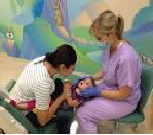
This is where Exclusive Pediatric Dental Clinic comes in. Many clinics which practice only Pediatric Dentistry are coming up. Their unique features such as the child friendly appearance, play area full of toys, TV set with cartoon films running and the dental staff well trained in handling kids make them different from a general dental clinic.

Also, presence of many other children, opportunity to observe other children’s treatment helps an anxious child relax and feel comfortable in a these clinics             . 

Moment of pleasure! 
When the pediatric dentist receives 
gift from the little patient as token 
of love!
Pediatric dentistry is “child-centered” not “tooth-centered”!!!
The ultimate aim of pediatric dentistry is not just to perform the dental treatment for the sake of relieving a toothache or solving the dental problem of the child. The goal is to give a child an overall comfortable and enjoyable dental experience so as to instill a “positive attitude” about dentistry in their mind.

The exclusive pediatric dental clinics serve the purpose much better! There remains no “fear factor” for visiting a dentist. Trip to their favorite “dentist uncle/aunty” becomes fun for them, performance of dental treatment being just a part of the game!


Saturday, 20 December 2014

Child’s first dental visit - “Get It Done In Year One”


When should you take your child to the dentist for the first time?

The answer is "First visit by first birthday." Surprising?


The child’s first dental visit and oral examination should take place by at least 1 year of age even if there are no dental problems at this age. This “well baby check” enables the dentist and the parents to discuss ways to nurture excellent oral health before any serious problems have had an opportunity to develop. Subsequently, regular check ups should be carried out every 6 months or as suggested by the dentist.


Why so early?


How does the dentist check my little baby? Will my baby allow for check up?


The baby’s check up is done in parent’s presence by taking parent’s help to hold the baby. This not only helps to control the baby’s movements but also gives emotional support to the baby. It is very common and normal for the babies to cry and even be resistant at the first appointment.

Though here is little or no effective communication between the dentist and the child, the child realizes that nothing “bad” happened; and the procedure was permitted by parents themselves. Thus crying and resistance improves over a period as the child grows up and these regular dental check ups contribute in making your child absolutely free of “fear of the dentist”!

What all information you will receive in the initial dental visits of your child?


So gift your baby a healthy smile on his/her first birthday by starting regular dental visits! It is never too early! Neither is it too late to start if your child is already more than 1 year old!

Believe in speciality?

Now you have an option of taking your child to a “Pediatric Dentist” who is specially trained for dental care of children…just as you have a “Pediatrician” who is a specialist in medical care of children!

Know more about Pediatric Dentistry in the next post!

Sunday, 7 December 2014

TEETHING


What is teething?
Your baby is teething when his or her first set of milk teeth break through the gums.

When does teething typically start?
Teething usually begins around 6 months of age. The lower front teeth usually come in first. Upper front teeth usually come in 1 to 2 months after the lower front teeth. Parents start to worry if the first teeth are not seen around 6 to 8 months; but it is normal for teething to start at any time between 3 months and 12 months of age.
 
What are the symptoms?
Some babies are fussier than usual when they are teething. This may be because of soreness and swelling in the gums before a tooth comes through.
Teething symptoms may begin about 3 to 5 days before a tooth breaks the skin. But symptoms can be present off and on for 1 to 2 months. They disappear as soon as the tooth breaks the gums. Many babies don't seem to be affected by teething. The most common symptoms of teething include:
  • Swelling, tenderness, or discomfort in the gums at the site of the erupting tooth.
  • Increased saliva, which can cause drooling. Drooling may cause a rash on the chin, face, or chest.
  • Biting on fingers or toys to try to relieve the gum discomfort.
  • Refusing to eat and drink because of mouth soreness.
  • Irritability and difficulty sleeping.
Mild symptoms that get better usually are nothing to worry about. Call your dentist if your baby's symptoms are severe or don't get better.

Diarrhea and fever during teething???
The common perception is that teething babies and children experience a slight rise in temperature and even diarrhea. However, teething process itself is not related to diarrhea. Because the babies keep on biting fingers or any objects that may be unhygienic, it is the gastrointestinal infection that actually leads to fever and loose motions. The child’s physician or pediatrician needs to be contacted for persistent complaints.


How can you help your baby be more comfortable while teething?
Give your baby cold teething rings to chew on to relieve teething discomfort

Here are some tips to help your baby feel better while teething:
Teething rings

  • Use a clean finger (or cold teething ring) to gently rub your baby's gum for about 2 minutes at a time. Many babies find this soothing, although they may protest at first. 
  • Provide safe objects for your baby to chew on, such as cold teething rings. 
  • Do not use over-the-counter (medicines bought without doctor’s prescription) pain reliever either syrups or gels as they are not safe. Their excessive swallowing by the baby may cause overdose and toxicity. If you want to try these products, talk to your doctor about which types are safe and how often to use them. 
 
Eruption and shedding time table of milk teeth
The four front teeth—two upper and two lower—usually erupt first, beginning as early as six months after birth. Most children have a full set of 20 primary teeth by the time they are 3 years old. The child’s jaws continue to grow, making room for the permanent (adult) teeth that will begin to erupt at about age 6 years. Primary teeth begin to shed between ages 6 and 7 years. This process continues until about age 12 years.


“Gaps” between milk teeth is a normal feature and it allows accommodation of large size of permanent teeth that will erupt later.